Meet the Indo-Swiss watchmaker whose watches are as expensive as sports cars
By
Shilpa Dhamija Updated 12 Jul, 2026 • Published 30 Mar, 2026
His watches are priced at an average $100,000 and yet attract a long waiting list of buyers. Even Chanel has acquired a stake in his company. He has won every major watch industry award in the world. Meet Maximilian Büsser, the Swiss-Indian watchmaker and founder of the unconventional watch brand MB&F
Maximilian Büsser started MB&F with a mad idea; unlearn everything he had learnt after spending decades in the Swiss watch industry and make outlandish watches that no one really needs. “But then, no one really needs mechanical watches either”, he points out in an exclusive interview with LuxuryVolt, “and yet there is an entire industry still thriving on them”.
Max knew MB&F was going to be a gamble, He went on with it anyway. In 2007, MB&F launched its debut watch – HM1 – a wristwatch that looked nothing like one. Its dial was shaped like a pair of alien eyes ( the alien from E.T.) and priced like a sports car (162,000 CHF). Max could have tested the market with a handful of pieces, instead he made a 100!
A 100 ridiculously priced watches, each waiting for a buyer who might never come.
“But we did sell them. All of them!” he laughs, with a lingering sense of disbelief !
MB&F first watch: Horological Machine no. 1
The success of HM1 encouraged Max to turbocharge the crazy, distilled into smaller runs of limited-edition horological art.
MB&F gradually built a loyal fan-base. By 2015, MB&F was competing with the big league. Max launched the ‘LM Perpetual’; a perpetual calendar watch priced at twice that of a Patek Philippe. With 581 hand-finished components, the watch took five years to develop. Max made 50 pieces and presented them at Baselworld, the same fair where Patek Philippe presents its novelties. “I hoped and prayed that at least half would sell”.
By the end of the watch fair, in less than a week, all were sold out. Demand exceeded expectations. Retailers had to be put on a waiting list. MB&F had become a ‘constant force’ to reckon with.
In just one decade, Max had created a brand that disrupted the rigid, age-old conventions of the world’s most closely guarded luxury industry. Better yet, he had finally found a space where being a misfit proved to be a distinct advantage.
The architecture of a misfit
Max grew-up in Lausanne, a provincial town in Switzerland, where in the 1970s, his unusual duality – half Swiss, half Indian-Parsi made him “an exotic rarity and thus a misfit”. As a kid, Max instinctively chose to hide in the background. “As a teenage I forced myself to blend in, but often felt uncomfortable to not be my true self”, he confesses.
Maximilian Büsser, CEO MB&F
As he grew up, Max dreamed of designing super cars, but instead chose “Micro-tech engineering, a safe choice which provided a diverse spectrum of career paths in Switzerland”. That decision eventually led him to a research project on mechanical watches, igniting a passion that would serendipitously define his career. He spent several years at Jaeger-LeCoultre before moving to Harry Winston, where he led the watch division.
On paper, everything was going well, but Max wasn’t content. He realised that he was still only conforming not creating the “crazy, unusual stuff” he dreamed of.
The missing part of the puzzle: A Parsi Deekra (Parsi boy)
“I don’t speak Hindi”, Max admits with regret. Born in Italy and raised in Switzerland, Max already had to juggle between Italian, French and English. “My mother didn’t want to confuse me with a fourth language”, he explains, adding that in the 70s, one could not have predicted India’s eventual ascent to a global superpower.
As a boy, Max joined his mother on her annual trips to Bombay to meet her Parsi family. For him it was less of a homecoming and more of a sensory assault. Accustomed to the quiet, orderly landscape of Switzerland, the teeming Indian metropolis was a shock. “The heat, the crowds, the sheer lack of space, it was overwhelming,” he recalls. “For a little white boy, I wondered what the hell is happening here?” For years, this cultural friction led him to suppress his Indianness.
It took me quite some time to understand the gift of being half Indian and the values I inherited. After all, it was my unique composition that became my greatest strength.
Max defines himself as half engineer, half dreamer. “The pragmatic-engineer is my Swiss side. The emotional, anything-is-possible spirit is my Indian side.”
His Parsi mother’s upbringing had such a profound impact on him that he consciously made the Parsi mantra “Good thoughts, good words, good deeds” as MB&F’s guiding principle.
How MB&F built a loyal collector community
Max’s success was no accident; it was a calculated response to the industry’s own inertia. Established brands had grown too comfortable recycling designs, making minor tweaks and launching them as hyped novelties. Seasoned collectors were growing weary of the charade. The market was ripe for true innovations. MB&F’s work came as a breath of fresh air and notably, without the usual snobbery.
“The architecture of his watches was something I had never seen before”, says Rohit Ramachandran, an Indian watch collector based in the UAE, who has amassed over eight MB&F watches. “I first fell in love with the brand when I saw its Legacy Machine 101. The oscillating balance wheel taking centre stage on the dial was truly unique”, he notes.
MB&F Legacy Machine 101
“MB&F exists not to tell time, but to inspire others to find their own true north and have the courage to be different,” explains Max. “Our unwavering sincerity in delivering great artistic horology has earned us a loyal community of collectors”.
Max’s goal was never to build a corporate behemoth, but to build a creative laboratory where he and his ‘Friends’ could act as true artists and engineers rather than mercenaries of the market.
“It seems incredible in today’s impersonal world”, Ramachandran points out, “but Max actually makes an effort to personally get to know each and every one of his customers”
Why fashion giant Chanel bought in
Despite surging demand, Max continues to resist aggressive scaling. After two decades, MB&F still produces fewer than 400 pieces annually, prioritising rigorous quality control over volume.
For now, restraint is strength, but the future will test it
Max started MB&F when he was about 38. Now at 58, with two young daughters and a company he built from his own savings, Max realised he needed a plan to protect his legacy. “My daughters are young, I don’t know if they want this. As the founder it is my responsibility to have a succession plan for the brand and its people”.
To find a solution, Max turned to family owned businesses who shared his creative perspective. “I showed Chanel a five-year plan with zero growth and less profit, they didn’t blink”, he reveals, and that’s how he knew they were the right care-takers. In 2024, Chanel bought a 25% stake in MB&F, “They will manage MB&F after I pass, but they will not acquire a majority stake while I’m alive”. MB&F has no other external investors.
Other than MB&F, Chanel also owns minority stakes in popular independent watch brands F.P. Journe and Romain Gauthier.
Can outsiders break into the Swiss dominated luxury watch market?
“The global dominance of the Swiss watch industry is not due to a monopoly on talent, but a unique ecosystem of suppliers that allows brands to thrive without massive overhead”, Max says, plainly.
While the high-end sector is notoriously difficult to penetrate, he insists “it’s possible to challenge the status quo of the Swiss watch industry if one leverages this specialised network.”
He also reveals that success in the luxury watch market is no longer tied to being physically present in Switzerland.
The real setback for emerging brands could be a lack of original identity. “Don’t try and copy, and don’t try to please with local flavours,” Max warns. International success requires a “completely innovative approach that offers something unique”.
With twenty-three original calibers under his belt, Max dismisses the idea that everything has already been invented, challenging newcomers to “move beyond repetitions and cheaper iterations. Just create genuine, distinct value.”
1. 162000 CHF = ₹53.86 Lakh in 2007 and ₹1.94 Crore in 2026.
FAQs
What does MB&F stand for? +
MB&F stands for Maximilian Büsser and Friends. Most MB&F watches are made in collaboration with independent Swiss masters who work with the brand on a project basis. They are the ‘Friends’ in MB&F. MB&F is an independent watch brand based in Switzerland.
Who is the founder of MB&F? Where is it based? +
Maximilian Büsser is the founder of MB&F. While MB&F is headquartered in Switzerland, Max lives in Dubai
Which awards has MB&F won? +
MB&F has won numerous awards across various GPHG categories over the years, including the prestigious “Aiguille d’Or” Grand Prix (Best-in-Show). GPHG stands for Grand Prix d’Horlogerie de Genève. It is like the Oscars of the watch industry.
Which is MB&F’s most expensive watch? +
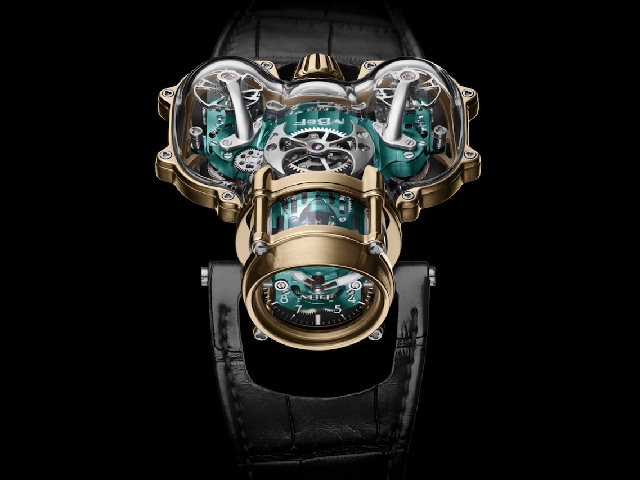
One of the most expensive watches by MB&F is the HM9 Sapphire Vision priced at $444,000 (excluding taxes). It was launched in 2021.
Shilpa is a world renowned journalist and an expert in decoding India and Asia’s luxury markets for global readers. Her original, in-depth reports and analysis are frequently featured in prestigious international titles across the UK, China, Hong Kong, Switzerland, and Oman.
Shilpa is a world renowned journalist and an expert in decoding India and Asia’s luxury markets for global readers. Her original, in-depth reports and analysis are frequently featured in prestigious international titles across the UK, China, Hong Kong, Switzerland, and Oman.
India is cutting import duties on many luxury goods; cars, watches, cosmetics & wines through new trade deals with the EU, UK, UAE, Switzerland and Australia. Lower taxes will boost demand of foreign luxury goods in India, encouraging more global brands to enter and expand in the market.
At key global red carpet events, Alia Bhatt has out-ranked icons like Zendaya and Kendall Jenner, while generating multi-million dollar EMV for brands like Gucci & L’Oréal. Discover how the Indian actress strategically built her influence from a teenage movie star to an ROI magnet from south Asia.
India is significantly reducing import duties on alcoholic beverages and liquor – premium wines, whisky, beer, rum, vodka and tequila – as part of new trade deals with the UK, EU, Australia, New Zealand, Switzerland and Finland. See which major alcobev brands and spirits will benefit the most.
His watches are priced at an average $100,000 and yet attract a long waiting list of buyers. Even Chanel has acquired a stake in his company. He has won every major watch industry award in the world. Meet Maximilian Büsser, the Swiss-Indian watchmaker and founder of the unconventional watch brand MB&F
Reliance Brands Limited (RBL) is the premium and luxury retail powerhouse of the Reliance Industries conglomerate. It is the India partner for global brands such as Balenciaga, Bottega Veneta, Burberry, Giorgio Armani, Tiffany & Co., Valentino, and Versace. It also holds significant stakes in leading Indian designers like Manish Malhotra and Abu Jani Sandeep Khosla.
Isha Ambani is the Executive Director of Reliance Retail Ventures Limited (RRVL), which is the parent company that owns and oversees RBL.
Aditya Birla Fashion Retail Ltd. (ABFRL) is India’s single largest fashion conglomerate with a turnover of $860.50 million (₹7,354.73 crore). ABFRL is the India partner of Galeries Lafayette and Christian Louboutin. It is also the majority stake owner of India’s most valuable luxury brand – Sabyasachi. Other Indian luxury and premium fashion brands in its portfolio include – Tarun Tahiliani. Shantnu & Nikhil, Masaba and Jaypore.
ABFRL is the fashion retail arm of Aditya Birla Group that recorded a consolidated revenue exceeding US$67 billion (approximately ₹5.6 lakh crore) in FY’25.
DLF (Delhi Land and Finance) is India’s leading luxury retail developer. It launched India’s first luxury-mall in New Delhi in 2008. In 2017, DLF launched another luxury mall – The Chanakya in New Delhi city centre. Together, these destinations host a definitive lineup of global and domestic fashion houses including Hermes, Louis Vuitton, Bvlgari, Gucci, Cartier, Bottega Veneta, Salvatore Ferragamo, Fendi, Tom Ford, and Jimmy Choo, alongside premier Indian couturiers like Tarun Tahiliani and Gaurav Gupta.
DLF is also India’s premier developer in the luxury real estate sector, renowned for creating ultra-luxury residential projects like The Camellias and The Aralias, that have the most expensive homes in the entire national capital region